Explore expert articles, clinical guides, surgical technique updates, and global market trends.
In-depth technical guides for pedicle screws, locking plates, PEEK cages, and surgical instruments.
Market analyses, regulatory developments, and export insights for orthopedic distributors worldwide.
A Bipolar Hip Prosthesis is an implant used in a partial hip replacement, often called hemiarthroplasty. It replaces the damaged ball at the top of the thigh bone, while the natural hip socket usually remains in place. The implant has a stem fitted inside the femur and a rounded head with two moving surfaces. One surface moves within the implant; the other meets the patient’s own socket. That design gives the hip room to move.
It is not the same as a total hip replacement. The difference matters. Surgeons may consider a bipolar implant for certain hip fractures, particularly displaced fractures of the femoral neck, but it is not suitable for everyone. Age alone does not determine the choice. Bone strength, general health, activity level, and the condition of the socket all matter. A careful clinical assessment is essential.
This guide explains how the prosthesis works, why a care team might recommend it, and what recovery may involve. It also covers possible complications, including infection, dislocation, persistent pain, and implant loosening. These outcomes are not inevitable, but no operation is risk-free. Recovery can include wound care, walking practice, and gradual return to daily tasks. Progress may be uneven; that can be frustrating. Questions about expected benefits, alternatives, and personal risks are worth discussing with an orthopedic surgeon. Individual advice depends on examination and medical history.
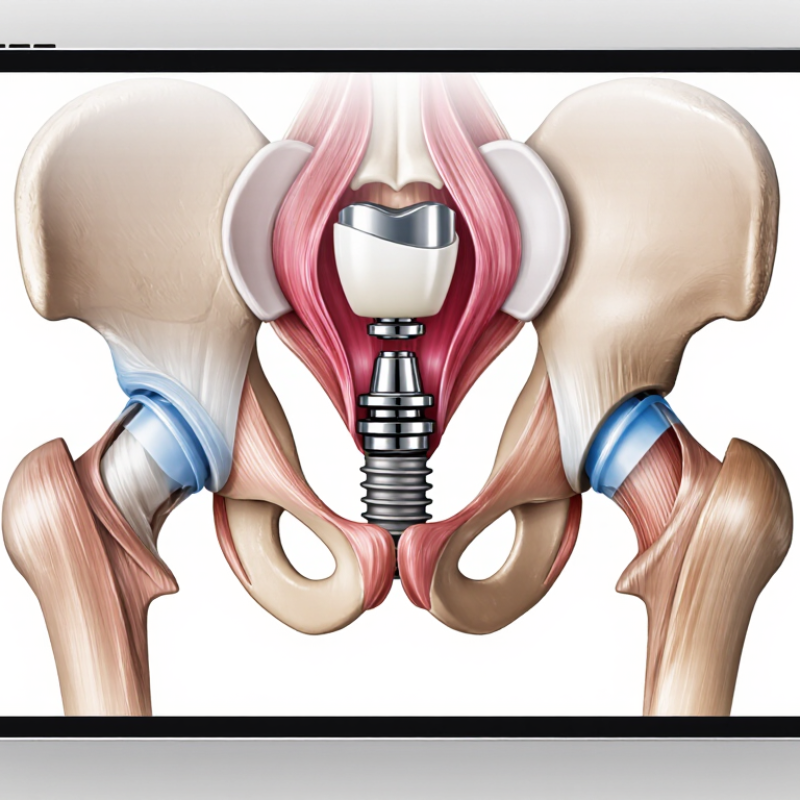
A bipolar hip prosthesis is a type of hemiarthroplasty: it replaces the femoral head but leaves the patient’s natural hip socket in place. Its defining feature is two bearings. A small metal head moves inside a larger outer cup, usually lined with polyethylene; the outer surface can also move against the socket. In theory, this two-bearing design distributes motion and may reduce rubbing inside the natural joint. In practice, movement does not always occur equally at both surfaces. The engineering sounds tidy. Biology is less tidy.
Surgeons may consider bipolar hemiarthroplasty for selected older adults with displaced femoral-neck fractures, weighing mobility, health, and socket condition. It is not a universal upgrade over a unipolar prosthesis; comparative research has not established a consistent functional advantage for every patient.
The American Academy of Orthopaedic Surgeons’ 2021 clinical practice guideline gives a strong recommendation for cemented stems in patients undergoing arthroplasty for femoral-neck fractures. That guidance concerns stem fixation, not proof that bipolar bearings are superior. After surgery, the practical details matter: pain, wound healing, safe transfers, and rehabilitation can shape recovery as much as the implant’s design. A useful discussion with the surgical team should cover both the potential benefits and the limits of the evidence.
A bipolar hip prosthesis is a type of partial hip replacement with two moving surfaces. Its defining feature is a small inner head that rotates inside a larger outer shell. In some designs, the inner head measures 22 or 28 millimeters across. It sits within a low-friction liner, often made of polyethylene. Two surfaces move.
The inner head articulates with the liner, while the shell’s rounded outside surface moves against the natural hip socket. This second articulation gives the implant its “bipolar” name. In theory, movement can occur at either surface; in practice, the balance depends on fit, tissue condition, and how the joint is loaded. A larger outer shell does not mean the inner head is larger. The measurements describe different parts.
This arrangement may help distribute motion, but it cannot prevent every complication or guarantee a particular outcome. Wear, loosening, and instability remain possible concerns. The geometry sounds tidy; real movement is less tidy. A surgeon considers factors such as bone quality, socket condition, and daily activity when choosing an implant. The right dimensions are specific to the patient and prosthesis design.
A displaced femoral-neck fracture means the broken bone ends have shifted out of alignment near the hip joint. In an older adult, this can interrupt blood flow to the femoral head and make healing less predictable. A bipolar hip prosthesis replaces that head with an artificial one. Its head has two points of movement: an inner joint and movement against the natural hip socket. The operation is a type of partial hip replacement, not a replacement of the entire joint.
It may be considered when an older person has a displaced fracture and the bone is unlikely to heal reliably with fixation. Age alone does not decide. Doctors also consider walking ability before the fall, other illnesses, bone quality, memory, and the person’s goals. A person who walked outdoors with a cane may have different needs from someone who needed daily assistance. That matters.
The choice has trade-offs. A bipolar prosthesis can allow earlier weight-bearing in many care plans, but surgery still carries risks such as infection, dislocation, blood clots, or confusion after anesthesia. Recovery depends on pain control, safe transfers, and rehabilitation; progress may be uneven. Families sometimes expect independence to return quickly. That is understandable, but not guaranteed. The care team should explain why this option fits the individual and discuss alternatives, including total hip replacement or fixation, when appropriate.
A bipolar hip prosthesis replaces the femoral head after certain hip fractures. Its rounded head moves within a second outer cup, which also contacts the patient’s acetabulum. Surgeons weigh the fracture pattern, walking ability, and socket health together. A displaced fracture in a frail patient may favor hemiarthroplasty, while strong pre-fracture mobility can make total hip replacement worth discussing.
NICE advises considering total replacement for patients who walked outdoors independently, are medically suitable, and are expected to remain independent in daily activities for more than two years. That is a selection guide, not a promise.
If the socket already has painful arthritis or damage, leaving it untouched may preserve a source of pain. With a healthy socket, bipolar hemiarthroplasty avoids adding an acetabular component and may mean a shorter operation.
Small details matter. The HEALTH trial followed 1,495 patients with displaced femoral-neck fractures: repeat hip procedures within two years occurred in 7.9% after total replacement and 8.3% after hemiarthroplasty. Dislocation was more frequent after total replacement, 4.7% versus 2.4% (HEALTH Investigators, New England Journal of Medicine, 2019).
Those group averages cannot predict one person’s result. In practice, surgeons also consider cognition, balance, medical risks, and the patient’s own goals.
The boundary is not always neat. A fracture image alone rarely captures how someone moved through their kitchen last month.
A bipolar hemiarthroplasty replaces the damaged femoral head with a prosthetic head that has two moving surfaces. A unipolar prosthesis has one main bearing surface, which moves against the patient’s natural hip socket. The design difference sounds simple. Real outcomes are less simple.
Clinical studies compare pain, walking ability, dislocation, acetabular wear, complications, and later surgery. Across many comparisons, neither design consistently outperforms the other on every measure. Some studies report modest functional or pain advantages with bipolar implants, especially in the short term; others find similar results. Differences may fade over time, and study methods vary. That matters.
For an older adult recovering from a hip fracture, the choice also depends on health, activity level, bone condition, and expected lifespan. A surgeon may consider whether reduced friction at the socket is worth the added mechanical complexity. Studies often include patients with different needs, and follow-up may be too short to capture gradual socket erosion. A clinic hallway walk can show early mobility, but it cannot settle long-term durability. Evidence helps frame the discussion, not replace an individual assessment.
It is a partial hip replacement used for some femoral-neck fractures. It replaces the femoral head while leaving the natural socket in place. Two surfaces move.
A small inner head rotates inside a larger outer shell, often with a polyethylene liner. The shell can also move against the natural socket. Motion may occur at either surface, but not always equally.
They describe the inner head’s diameter in some designs. They do not describe the larger outer shell. The right dimensions depend on the patient and implant design.
Surgeons may consider it for selected older adults with displaced femoral-neck fractures. They assess health, walking ability, bone quality, and socket condition. Daily routines matter, too.
It may be discussed when a patient walked independently outdoors before the fracture and is medically suitable. Expected independence in daily activities also matters. These factors guide discussion, not outcomes.
A healthy socket may work with the outer shell. Painful arthritis or socket damage can remain a source of pain if left untreated. A fracture image rarely tells the whole story.
No. The design may distribute motion, but research has not shown a consistent functional advantage for every patient. Wear, loosening, and instability remain possible. The engineering sounds neat; bodies are less predictable.
Pain, wound healing, safe transfers, and rehabilitation all matter. The implant is only one part of recovery. Even getting from bed to a chair can take practice.
A Bipolar Hip Prosthesis is a type of hemiarthroplasty used to replace the damaged femoral head while leaving the hip socket in place. Unlike a unipolar implant, it has two points of movement: a small inner head, commonly 22 or 28 millimeters in diameter, moves within an outer shell, and the shell can move against the natural acetabulum. This dual-bearing design allows motion to occur at more than one surface.
Surgeons may consider this implant for older adults with displaced femoral-neck fractures. Selection depends on factors such as the fracture pattern, the patient’s mobility and general condition, and the health of the acetabulum. Clinical studies compare bipolar and unipolar hemiarthroplasty by examining outcomes such as pain, mobility, complications, and the need for further surgery. The most suitable option varies by patient, so the decision is made based on individual clinical needs.